An example: Georgia salt marsh energy flow study using EcoNet
We present an eight-compartment model based on John M. Teal's classic study of energy flow in a Georgia salt marsh [19,18]. Followed by the model description, we provide the EcoNet model and go over essential network analysis results.
Model Description

|
The model represents the energy budget for one square meter of salt
marsh. Compartments are measured in
 and flows are measured
in
and flows are measured
in
 . Energy enters the salt marsh through primary production
at compartments salt marsh cordgrass Spartina and algae. Much
of this energy is lost through respiration by these plants, but the
remainder enters the salt marsh food web. Bacteria and insects feed
directly on the Spartina, and spiders, in turn, feed on the
insects.
. Energy enters the salt marsh through primary production
at compartments salt marsh cordgrass Spartina and algae. Much
of this energy is lost through respiration by these plants, but the
remainder enters the salt marsh food web. Bacteria and insects feed
directly on the Spartina, and spiders, in turn, feed on the
insects.
A substantial portion of the Spartina dies and enters the detritus pool. Nematodes feed on bacteria and detritus, and mud crabs feed on the nematodes. Every compartment in the model contributes to the detritus pool through fecal material (for the animal compartments) and dead tissue. Every compartment except detritus, the only nonliving compartment in this model, dissipates energy through respiration. One of the surprising findings was that this salt marsh exported substantial amounts of energy through detritus (0.6% of incoming radiation). Detritus export is represented by a loss term in the model.
|
![\includegraphics[width=5.5cm]{teal.epsi}](teal2.gif)
Because energy, rather than carbon or nutrients, is the currency for this model, dissipation rates are high. Energy dissipates rapidly because of respiration losses and detritus export. However, energy does cycle in this ecosystem in the form of detritus. A kilocalorie of energy can make multiple passages through all of the non-plant compartments before exiting the system.
Flow analysis
|
In the matrix N given above, 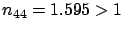 represents the fact that a
unit of energy in detritus is more likely to cycle through the salt
marsh food web and reenter the detritus compartment before being dissipated
from the system.
represents the fact that a
unit of energy in detritus is more likely to cycle through the salt
marsh food web and reenter the detritus compartment before being dissipated
from the system.
Bacteria, nematodes, and mud crabs are all part of the detritus-based
salt marsh food web, and thus have the potential to cycle energy in
this ecosystem (
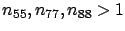 ). By contrast, a unit of
energy that enters the Spartina, algae, insects, or spiders
compartment will never again reenter those compartments (
). By contrast, a unit of
energy that enters the Spartina, algae, insects, or spiders
compartment will never again reenter those compartments (
 ),
because all of their energy is derived from primary production.
),
because all of their energy is derived from primary production.
The N matrix traces the throughflow generated by inputs into various
compartments in our model. The non-zero entries in the first row of
N indicates that a unit of energy input into Spartina generates
energy flowing through every compartment except algae. Detritus is
the largest recipient of energy derived from Spartina, both
from the direct movement of Spartina to detritus (
 )
and from indirect pathways (
)
and from indirect pathways (
 ). Therefore
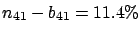 of this energy travels through the food web before entering the detritus
compartment. There is no direct flow from Spartina to mud crabs
(
of this energy travels through the food web before entering the detritus
compartment. There is no direct flow from Spartina to mud crabs
( ), and the shortest path between them is (See figure):

 of energy that is
captured by Spartina photosynthesis.
of energy that is
captured by Spartina photosynthesis.
Similarly, the second row of N indicates that the energy inputs
to algae generate throughflows in four of the model compartments.
Nearly 40% of this energy will pass through the detritus compartment,
and 16% will reach bacteria through consumption of detritus (
 ).
).
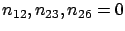 , therefore Spartina, insects, and
spiders cannot capture energy derived from photosynthesis by algae.
, therefore Spartina, insects, and
spiders cannot capture energy derived from photosynthesis by algae.
Although energy only enters the salt marsh through photosynthesis
by Spartina and algae, the B and N matrices trace flows
generated by hypothetical inputs into all compartments in the model.
For example, of a unit input of energy in nemotodes, nearly
 goes directly to detritus and less than 1% is consumed by mud
crabs (
goes directly to detritus and less than 1% is consumed by mud
crabs (
 ), with the remaining 24% lost to respiration.
From the mud crabs, the energy is either lost through respiration
or recycled as detritus (see figure). The energy
in detritus can reenter the detrital food web or be washed out to
sea. Through the detrital food web, a small fraction of this energy
(
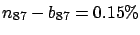 of the original input) will make at least
a second passage through the mud crab compartment.
of the original input) will make at least
a second passage through the mud crab compartment.
Storage and Utility Analysis
The storage analysis matrix S traces the storage generated by a constant rate of energy inputs into
different compartments in the model. For example, a rate of
The utility analysis matrix U indicates interaction types and strengths
among compartments in this network. Some of these relationships are
straightforward. For example, insects feed on Spartina, so
the addition of a unit of Spartina benefits the insects (
Because of multiple branches in the food web, some relationships are
more complex, and may be different than what one may derive from the
network diagram (figure). For example, even
though insects produce detritus, the addition of a unit of insects
is detrimental to the detritus compartment (
DHTML Menu By Milonic JavaScript |
 energy input into Spartina will generate
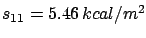 stored energy in Spartina. Because of recycling in the detritus-based
food web, even more energy from this input will be stored in the detritus
compartment (
stored energy in Spartina. Because of recycling in the detritus-based
food web, even more energy from this input will be stored in the detritus
compartment (
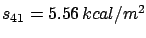 ). Smaller amounts of energy
will be stored in all of the other compartments reachable from Spartina.
). Smaller amounts of energy
will be stored in all of the other compartments reachable from Spartina.
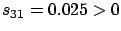 ),
and the addition of a unit of insects is even more detrimental to
the Spartina (
),
and the addition of a unit of insects is even more detrimental to
the Spartina (
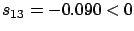 ). Indirect effects can be
traced using the utility analysis matrix. For example, the addition
of mud crabs has a negative effect on their prey, nematodes (
). Indirect effects can be
traced using the utility analysis matrix. For example, the addition
of mud crabs has a negative effect on their prey, nematodes (
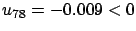 ),
and in turn, benefits algae and bacterial compartments, on which nematodes
feed (
),
and in turn, benefits algae and bacterial compartments, on which nematodes
feed (
 ) [
) [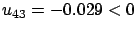 ), because
these insects are consuming (and subsequently respiring) additional
energy from Spartina that would otherwise go into detritus.
), because
these insects are consuming (and subsequently respiring) additional
energy from Spartina that would otherwise go into detritus.